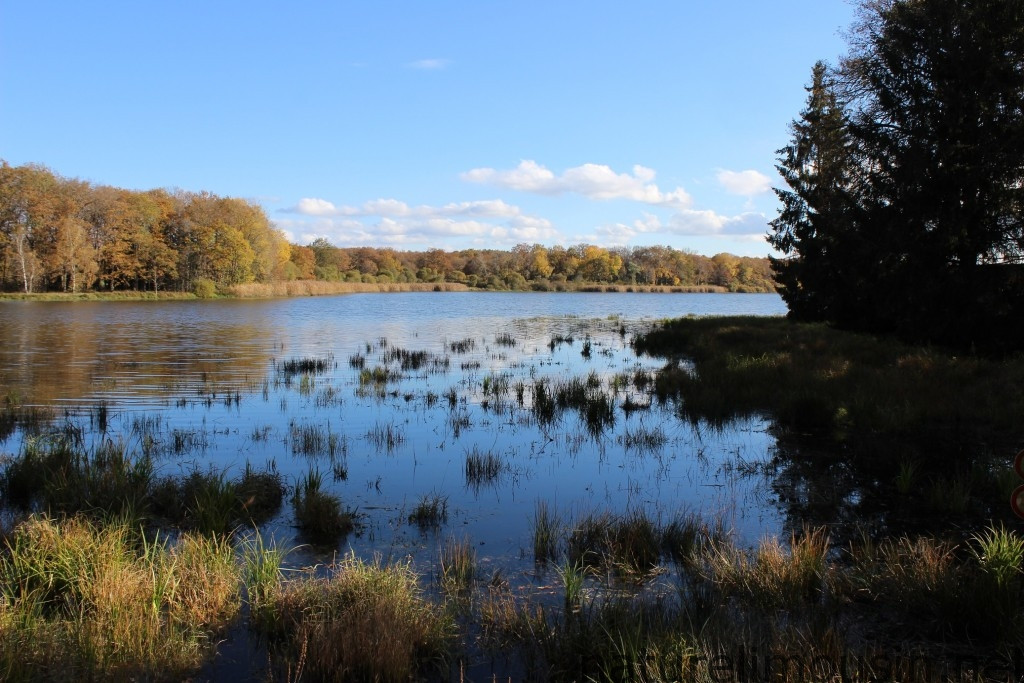


Description
Étang de Tête de Boeuf is one of the lakes of the Gouzon basin, the only sedimentary basin in the area. The lakes and ponds are generally shallow, with gently sloping banks and very diversified vegetation, constituting a refuge for nesting, migrating and wintering birds. Along with the Etang des Landes National Nature Reserve, the Etang de Tête de Boeuf is one of the centerpieces of the ponds in the Gouzon basin. In winter, ducks are present in often high numbers (kačica lyžičiarka, kačica chripľavka, lyska čierna, kačica chrapka). The site hosts hlaholka severská almost every winter. In nesting, the reed beds are home to marsh passerines, such as the trsteniarik bahenný and the trsteniarik malý, or more occasionally herons such as the bučiačik močiarny and the volavka purpurová. During the migration period, water birds abound: when the levels are high as in spring, the kačica chrapačka is regularly observed at the lake, and when the levels drop at the end of summer, waders are regularly observed. For example močiarnica mekotavá.
_________________________
Français: Site Natura 2000, l'Étang de Tête de Boeuf présente un grand intérêt en termes de biodiversité, et notamment un intérêt ornithologique. Les étangs du bassin de Gouzon, seul bassin sédimentaire du département, présentent une biodiversité riche en raison de leur typologie : il s'agit généralement d'étangs peu profonds, avec des berges en pente douce et des faciès de végétation très diversifiés, constituant un refuge pour l'avifaune nicheuse, migratrice et hivernante. Avec la Réserve Naturelle Nationale de l'Étang des Landes, l'Étang de Tête de Boeuf constitue l'une des pièces maîtresses des étangs du bassin de Gouzon. En hivernage, les anatidés sont présents en nombre souvent élevé kačica lyžičiarka kačica chripľavka lyska čierna kačica chrapka. Le site acceuille presque chaque hiver le hlaholka severská. En nidification, les roselières abritent des passereaux paludicoles, comme la trsteniarik bahenný et le trsteniarik malý, ou plus occasionnellement des ardéidés tels que le bučiačik močiarny et le volavka purpurová. En période de migration, les oiseaux d'eau abondent : lorsque les niveaux sont hauts comme au printemps, on y observe régulièrement la kačica chrapačka, et lorsque les niveaux baissent en fin d'été, on y observe régulièrement des limicoles faisant une brève halte comme la močiarnica mekotavá.
Details
Access
The site is private, and the best point of observation and parking for vehicles remains the dyke of the pond.
_________________________
Français: Le site est privé, et le meilleur point d'observation et de stationnement pour les véhicules reste la digue de l'étang.
Terrain and Habitat
Wetland , Grassland , Forest , ReedbedsConditions
FlatCircular trail
NoIs a telescope useful?
YesGood birding season
All year roundBest time to visit
Spring , Autumn , Autumn migration , Spring migration , WinterRoute
Wide pathDifficulty walking trail
EasyAccessible by
Foot , Bicycle , CarBirdwatching hide / platform
NoExtra info
The best time to observe birds on the site is the end of the day, which often offers excellent light and avoids morning and afternoon backlights.
_________________________
Français: Le meilleur moment pour faire de l'observation sur le site reste la fin de journée, qui offre souvent d'excellentes lumières et permet d'éviter les contre-jours du matin et de l'après-midi.


 ) to insert bird names in your own language. The birdnames will automatically be translated for other users!